The Future of AI at Work Is a Button on Some Guy's Desktop in Duluth
The hype is about agents that never sleep. The ROI is a $4 script that gives him three days a year back.
I recently read a LinkedIn article comparing AI spend and hype to a lot of sawdust with no furniture to show for it. It went viral. CEOs and CFOs at Fortune 500 companies were sharing it.
It nailed something I’ve seen firsthand. AI is being pushed by leadership everywhere, but most employees don’t know how to use it. They get handed a Claude account, shown a basic HTML dashboard, and told to use it. Cool. The shop manager in Minnesota is 100% going to revolutionize his operations now that he’s been handed $100 in Claude credits and a desktop app set to Sonnet 4.6 on low reasoning.
Meanwhile, stories are flying around of solo founders (Peter Steinberger) building a viral open-source agent in a few months and getting scooped up by OpenAI. Or literally everyone and their brother is talking about agents and how agents can work in the background 24/7. You know what else can do that? Software!! Leaders hear these buzzwords and the hype around them and try to apply them to their businesses. They aren’t wrong to, but they’re being sold the wrong solutions for their problems.
The shop manager in Minnesota doesn’t need Claude churning 24 hours a day doing low level tasks. What he needs is a Python program he can double-click on his desktop that runs his weekly report. He needs a deterministic process he can run to knock out toil. He doesn’t need an agent doing those things for him.
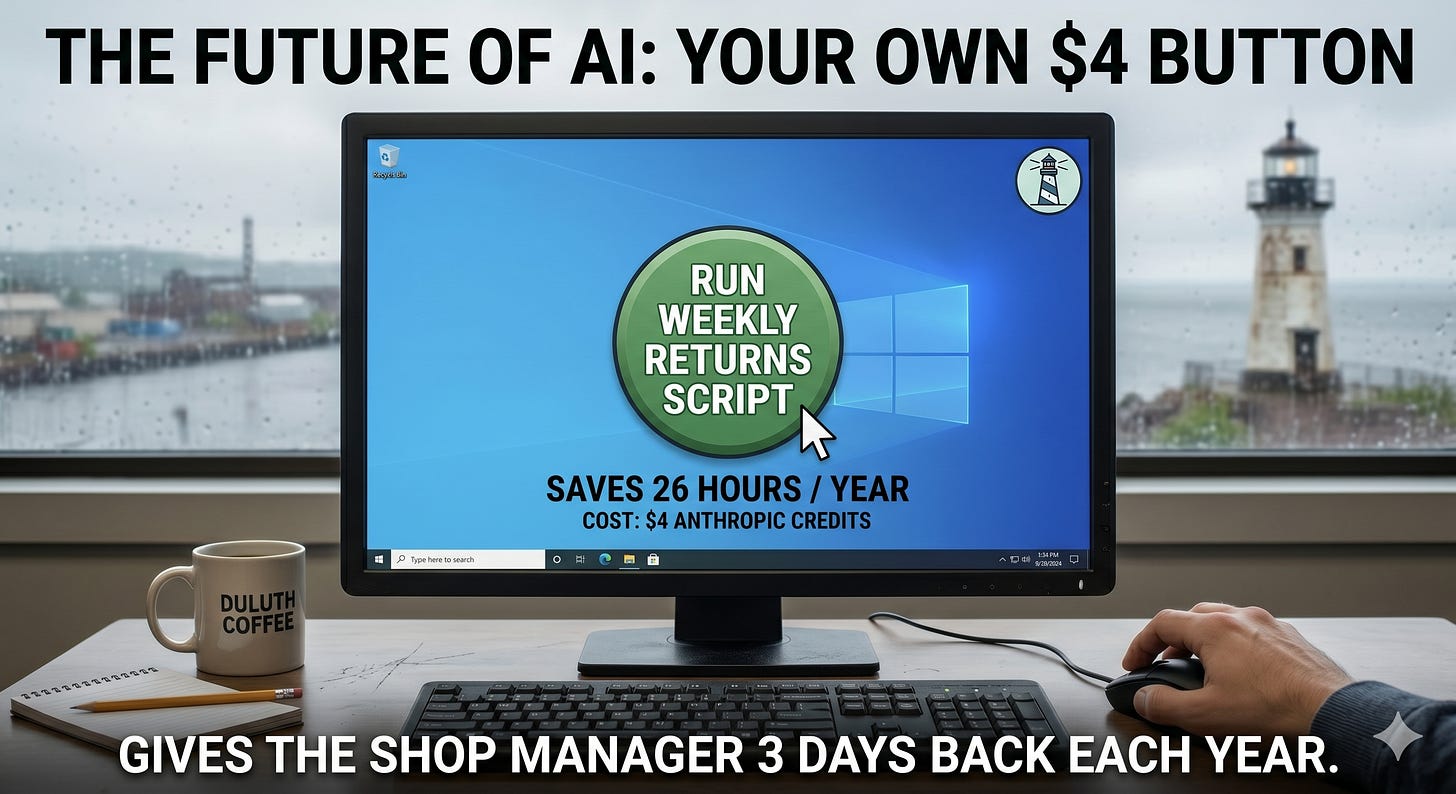
AI is incredible at creating custom software for people like that shop manager. The example I gave earlier actually happened. I was working with someone trying to figure out how Claude could actually help his day to day. We talked through some options and he landed on the weekly returns Excel doc he manages by hand. We fired up Claude Code, I explained the difference between Code, Cowork, and Chat, and we got started. We hit a couple of minor snags and had to install Python on his machine, but that was quick. Sonnet (on Extra effort) wrote a quick Python script and put a shortcut on his desktop. He double-clicks it, and it refreshes his Excel and sorts it the way he does every Monday.
Boom. He and Claude had built his first piece of software, for a task he does every single week. It lives right on his computer, so no fighting to get it hosted, no dealing with IT. No worrying about Claude making things up, since this was just Python applying rules to his data. Thirty minutes from idea to a working MVP, and now he knows how to iterate on it.
The shop manager went from never having touched an agentic coding tool to owning his own application. More importantly, he now knows how to use Claude Code and can teach others what he learned.
The beginner levels of using AI look like this:
Level 0 - Never touched an AI tool
Level 1 - Used ChatGPT, Claude Chat, Google Gemini, or Microsoft Copilot
Level 2 - Used Cowork or agentic coding tools for basic tasks
Level 3 - Used agentic coding tools to create applications
Level 4 - Deployed apps or websites onto a server
Level 5 - Incorporated and embedded AI directly into a tool or process
Level 6 - Created a legitimate agent like an OpenClaw or Hermes
Going from 0 to 1 is incredibly easy. 1 to 2 usually takes curiosity or some nudging from your company. 2 to 3 is the real jump for enterprises. This is where individuals can actually start making their days more meaningful. Cutting out a repetitive 30-minute weekly process saves 26 hours over a year. That’s over three full work days handed back to that employee.
Knock out a couple of those in a year and you’re handing real time back to the business. Walking the shop, talking to customers, thinking about how to make the business better. All things people actually enjoy doing.
None of this needs a live agent monitoring some system 24 hours a day. Is it perfect? Probably not. The cost was 30 minutes and $4 in Anthropic credits.
The value from AI is real for businesses, but it’s often not in multi-tier agentic workflows that handle a process end to end. (Those can work. I’ve seen a very, very powerful one in real life and it rocks.) It’s usually in the non-sexy stuff, like automating 95% of a boring Excel process for a middle manager in Middle America.
Start teaching your employees how to use these tools effectively (I’m happy to help with that), then let them find the processes they hate doing on a regular basis.
Want the video version? I walk through these tools step by step on YouTube: youtube.com/@Rubicon-AI
I’m Logan. I run Rubicon, where I help companies put AI to work.
Originally published on Substack.